

Attorney General Jeff Jackson Secures up to $645 Million for North Carolina in Landmark Child Safety Settlement with Meta

Instagram and Facebook to Make Major Child Safety Upgrades
FOR IMMEDIATE RELEASE
Wednesday, August 26, 2026
Contact: comms@ncdoj.gov
919-538-2809
RALEIGH – Meta, which owns Instagram and Facebook, will pay up to $645 million, with a guaranteed minimum of $451 million, to North Carolina and make major child safety upgrades to its apps in a landmark settlement with Attorney General Jeff Jackson and 51 bipartisan attorneys general. Meta will pay up to $17.1 billion to the states – the second-largest state consumer protection settlement in history and the largest big tech settlement ever.
The child safety upgrades will include comprehensive new measures to determine users’ age and keep children under 13 off the platforms. In addition, Meta will set default limits on the amount of time teens ages 13 to 17 can use Facebook and Instagram and give parents more control to adjust those settings in ways that work for their families.
Meta will also shut off feeds overnight, stop sending feed push notifications during the school day, and hide like counts, all by default. In addition, Meta will disable filters that mimic plastic surgery and tell parents when a suspicious person is contacting their teen. An independent auditor will check Meta’s work and publish what it finds.
“This is about protecting kids and empowering parents,” said Attorney General Jeff Jackson. “We know that this company built these apps to keep kids hooked and misled parents about what was happening. Today, Meta has to change those features and hand parents the controls.”
North Carolina is slated to receive up to $645 million through 2035 from the settlement. Attorney General Jackson is encouraging the General Assembly to use the money to fund after-school and summer school programs across the state, crisis helplines for struggling children, and school health personnel.
What the states alleged:
North Carolina, under then-Attorney General Josh Stein, joined 32 other states in suing Meta in federal court in October 2023. The states alleged that Meta violated state consumer protection laws by designing Instagram and Facebook to increase the amount of time children spent using them while publicly downplaying risks to young users. The states also alleged that Meta violated the federal Children’s Online Privacy Protection Act by collecting personal information from children under 13 without obtaining required parental consent.
The case relied significantly on Meta’s own internal records.
- Meta’s researchers identified features that hooked children into coming back to the apps. Internal documents discussed children’s sensitivity to intermittent variable rewards and described how Instagram’s Explore page, recommendations, and social connections could deliver repeated dopamine responses. One internal document said younger users generally had more difficulty with self-regulation.
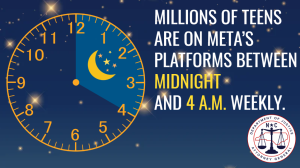
- Instagram interrupted teens’ sleep and learning. Meta knew that millions of teens use Meta’s platforms between midnight and 4 a.m. on a weekly basis. It also employed numerous notifications to draw children in, disrupting their school days.
- Instagram could lead children toward more harmful content. Meta’s internal testing showed that when users began following eating-disorder-related accounts, Instagram could recommend additional eating-disorder-related accounts.
- Meta’s own research raised concerns about like counts and appearance comparison. Meta knew prominently displayed like counts could cause young users to compare themselves to others and feel worse about themselves. One internal document said social pressure was, to a large extent, “built-in to the Instagram experience.”
- Employees raised concerns about face-altering filters. Internal Meta discussions revealed that employees warned executives, including Mark Zuckerberg, that filters that mimicked cosmetic surgery could contribute to body-image problems among young girls.
- Meta knew millions of children under 13 were using Instagram. In one instance, Meta estimated that Instagram had approximately four million users under 13. At other times, Meta had backlogs of millions of accounts reported for being under 13.
- The alleged conduct occurred at enormous scale. The states alleged that approximately 22 million teens log onto Instagram in the United States each day.
Even though Meta possessed this information, it continually assured parents that its platforms were designed to be safe and appropriate for children and teens.
What changes for children and parents:
Upon approval of the settlement by the federal court, teens will see changes on their Instagram and Facebook accounts within a few months. These changes will happen by default for all users ages 13 to 17. Parents will be able to change settings and increase or decrease limits for their teens by creating their own Instagram or Facebook account and linking it to their teen’s account. Parents will also be able to get data about their teen’s social media use.
Meta will be required to do more to verify the age of young users and remove children under 13 from the platforms. Once Meta determines that a user is 13 to 17 years old, it will implement the following protections on Instagram and Facebook:
- Daily Time Limit: Teens will only be able to access their account for two hours every day. After they hit the two-hour limit, the account will time out until the next day. They won’t be able to scroll or access their feed, but they will be able to send direct messages on Instagram and Facebook.
- Nighttime Block: The apps will not be accessible from midnight to 6 a.m. every night to protect teens’ ability to sleep. They won’t be able to scroll or access their feed during those hours. Millions of teens use Meta’s platforms between midnight and 4 a.m. on a weekly basis.
- No School Hour Notifications: During school hours, Instagram and Facebook push notifications for teens will be off (8 a.m. – 3 p.m. on weekdays from Aug. 15 to June 15). Children receive more than 200 notifications on their phones per day, of which nearly 23% happen during school hours.
- Scrolling Pauses: Meta will also now be required to put up roadblocks to prevent mindless scrolling. At every 15 minutes of continuous app usage, Instagram and Facebook will display a pop-up notification to discourage teens from endlessly scrolling. Harder pauses will kick in once children have been on the app for 60 minutes.
- Likes: Meta will turn off counts of likes and reactions by default on all posts, stories, and reels to help prevent teens from comparing themselves to others – which has been shown to have serious negative impacts on their self-image.
The new protections will happen across devices – a teen who spent two hours on Instagram on their phone won’t be able to switch over to their account on their tablet to get additional time. Meta will also work to identify teens who have multiple accounts so they can’t use them to evade time limits.
In addition to the default app changes, Meta will also:
- Give teens the option to select a non-personalized feed that isn’t determined by Meta’s algorithm and instead displays posts in a chronological order.
- Work with parents, teens, and child safety experts to continually evaluate and improve efforts to prevent showing children inappropriate content. That includes sexually explicit content, illegal drug use, and other content that might have an overall harmful effect if viewed excessively, such as diet and exercise fitness content that could promote eating disorders.
- Make teen accounts private by default and prevent teen accounts from being recommended to suspected unsafe users.
- Let teens report many types of harmful content, including bullying, harassment, suicide, self-harm, violent or disturbing content, and sexual content. Meta will also respond to the vast majority of those reports within six hours of receiving them.
“I took Meta to court in 2023 because I alleged it was knowingly endangering kids to make more money,” said Governor Josh Stein. “Today Attorney General Jackson is holding Meta accountable, and we begin to right this wrong and protect kids. I look forward to working with the legislature to use these funds to improve teens’ mental health.”
“On the Mo Wants to Know tour, I heard the same request in every region of North Carolina: our young people need more mental health support. Educators said it. Parents said it. Students said it themselves,” said Superintendent of Public Instruction Maurice “Mo” Green. “Our Youth Risk Behavior Survey confirms it, showing disturbing numbers of students experiencing persistent sadness and hopelessness, or seriously considering suicide. I thank Attorney General Jeff Jackson and Governor Josh Stein for addressing this need through today’s historic settlement, a meaningful step for every young person in North Carolina.”
Tennessee, California, Colorado, Kentucky, New Jersey, and Alabama, Alaska, American Samoa, Arizona, Arkansas, Connecticut, Delaware, District of Columbia, Georgia, Hawaii, Idaho, Illinois, Indiana, Iowa, Kansas, Louisiana, Maine, Maryland, Massachusetts, Michigan, Minnesota, Mississippi, Missouri, Montana, Nebraska, Nevada, New Hampshire, New York, North Dakota, Northern Mariana Islands, Ohio, Oklahoma, Oregon, Pennsylvania, Puerto Rico, Rhode Island, South Carolina, South Dakota, Utah, Vermont, Virginia, Washington, West Virginia, Wisconsin, and Wyoming have signed on to the settlement.. The payments will be made in 10 installments over eight years. Meta will pay the first installment 30 days after the settlement gets court approval, and then pay following installments every Jan. 15. North Carolina will receive at least $451million to resolve its claims. Further, Meta will pay an additional $194 million to North Carolina and implement even more protective time limitations for teens when the states have accomplished industry-wide adoption of protections similar to this settlement.
A copy of the settlement is available here.
###
GRAPHICS (AVAILABLE FOR MEDIA USE)



STATISTICS ON SOCIAL MEDIA USAGE (AVAILABLE FOR MEDIA USE)
- Teens exceeding three hours per day of social media face double the risk of depression and anxiety. (Source: U.S. Surgeon General)
- Over half of teens have four hours or more of daily screen time. (Source: CDC)
- Roughly half of teens (48%) say social media sites have a mostly negative effect on people their age, up from 32% in 2022. (Source: Pew Research Center)
IMPACTS OF SOCIAL MEDIA USAGE (AVAILABLE FOR MEDIA USE)
- Ashlee Thomas began following clean eating influencers on Instagram when she was 14. (Source: CNN: How Instagram led to two teens’ eating disorders, Oct. 2021)
- “And the bodies she considered ideal streamed down her timeline every single day, with every ‘like’ and comment enticing her to emulate the types of bodies she saw…One commenter reacted to photos Thomas posted of herself by writing that her stomach was fat. At some point she stopped eating. She said her parents tried everything to get her to eat. Child welfare authorities were called on them as they resorted to force feeding her.”
- At age 11, Alexis Spence created her first Instagram account and began encountering eating disorder and self-harm content. (NBC News: Family sues Meta, blames Instagram for daughter’s eating disorder and self-harm, June 2022)
- “At the height of her addiction to Instagram, Spence said she had had multiple accounts and would access them for hours in the middle of the night so as not to alert her parents, who had grown concerned by her increasingly hostile and uncharacteristic behavior. One time, she punched a hole in the wall when they tried to take away her device, noted the suit, which attributed her conduct to Instagram’s ‘addictive design and product features.’”
Legal Disclaimer:
EIN Presswire provides this news content "as is" without warranty of any kind. We do not accept any responsibility or liability for the accuracy, content, images, videos, licenses, completeness, legality, or reliability of the information contained in this article. If you have any complaints or copyright issues related to this article, kindly contact the author above.
